
Key Takeaways
Sin is not a moral judgment, so much as it is a relational rupture: disconnection from source, from others, and from creation.
The cultural obsession with self has consequences that reach far beyond any one individual life.
Turning toward one another, and toward creation, is not just the antidote to disconnection. It is the antidote to sin itself.
Observation
I was born Catholic, inheriting a faith I didn’t choose. For many of us, this is how we inherit beliefs, languages, and assumptions about the world. By the time I hit medical school, I had outgrown my childhood faith, trading Sunday mass for Richard Dawkins. I embraced atheism with both confidence and arrogance that science could explain everything. What I didn’t respect at the time was how spiritually untethered I had become, and how much of my self-destructive behavior flourished in that vacancy.
What followed was a natural motivation catalyzed by my incessant curiosity to understand more. I eventually studied Hinduism, Buddhism, Zen, Confucianism, Daoism, Judaism, and Islam, not academically, but with the kind of appetite that moved that me from one tradition to the next yearning for something I couldn’t yet name. I commemorated my searching with milestone tattoos representing multiple faiths. I purchased and used Tibetan singing bowls. I visited temples and religious sites in various countries I’d travel to. In early sobriety, I adopted the principle of ahimsa—a Sanskrit word meaning non-violence and no harm—in repentance for a lifetime of harmful choices, including embracing veganism. I now attend a non-denominational Christian church in Venice, and I am currently pursuing a Master of Arts in Theology at Asbury Theological Seminary with a focus on Intercultural Studies.
I am not studying theology with the intent of becoming an academic, pastor, or missionary. I am not interested in ranking faiths, discrediting beliefs, or coercing anyone toward what I value. I am a seeker. And there are no bigger questions than the ones surrounding God. Does He exist? Do we have souls? Is this life temporary and finite, or is there an eternity we all belong to? These are the questions that stir me. But equally, I have watched religion and theology be weaponized too many times to count, used to condemn, catalog, and divide. That is precisely why I want to talk about sin.
Revelation
Sin is a word that arrives with its verdict already attached. Most of us hear it and immediately picture a judge, dishing out verdicts of right and wrong, condemning our souls to heaven or hell. It is the proverbial finger pointing that is loaded with shame. That image has done enormous damage, and it is not what I am here to talk about.
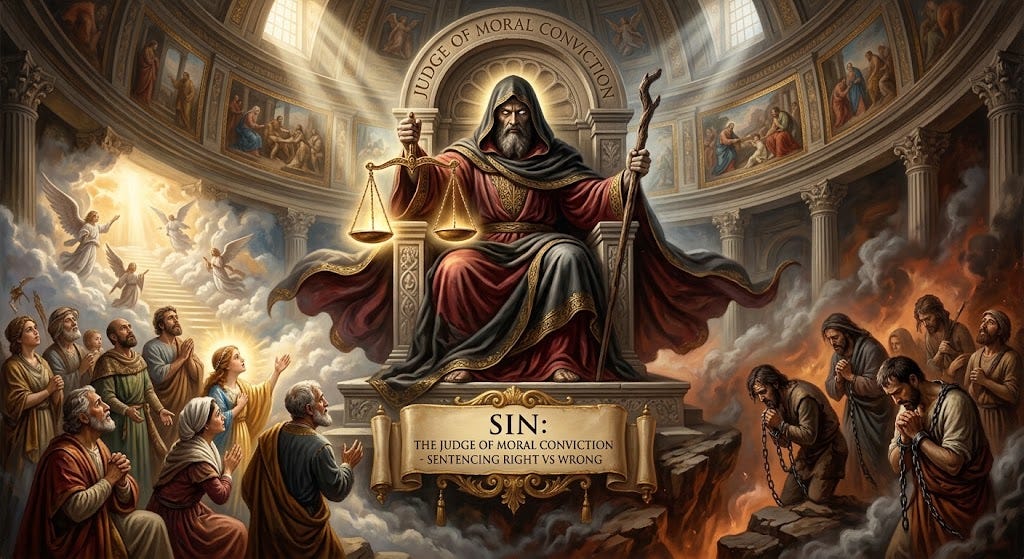
I want to go back to the beginning. Back to Genesis 3, where sin enters the human story not as a moral infraction but as a relational rupture. Adam and Eve’s sin was not primarily about eating a piece of fruit; it was about unbelief. They stopped trusting the source they had been connected to and acted on self-will instead, disconnecting themselves from God and turning inward toward the self. That is the original movement of sin: not evil in the dramatic sense, but the quiet, ordinary act of making ourselves the center of the universe.
In practical terms, sin is the choosing of ourselves over each other. It is not a theological abstraction, but a cultural condition.
Meaning
We have built an entire civilization around the individual self as the primary unit of meaning. Social media gives every person a profile, a platform, a curated presence. The Era of Self has given rise to self-care, self-help, self-optimization, and self-promotion. The algorithms that govern our attention are not neutral. They are designed to confirm, to flatter, and to endlessly fold us back into ourselves.
When we stop caring for one another, when we stop orienting toward something larger than our own lives, something begins to grow in the emptiness. It spreads the way a disease does, quietly, systemically, reaching further than any single act or intention. We see it in our loneliness statistics. It is alive in the busyness epidemic that has made indifference and apathy a way of life. Our planet is evidence of its existence, warming at a rate that can only be explained by our collective, cumulative turning away from creation.
I am not writing this to moralize. I am writing this because the posture we adopt determines whether we orient toward each other or away from each other, and in that direction lies either hope or despair. If we fail to see our suffering and our disconnection as related, we fail to see the opportunity for something new. We will condemn ourselves to live entirely inside the consequences of our most self-serving choices.
The traditions I have been studying, across more than one faith and more than one culture, keep returning to the same counterintuitive truth: the antidote to disconnection is not a program, a doctrine, or a self-improvement plan. It is the act of turning toward one another, toward creation, toward something larger than ourselves. That movement, however small, is where everything begins.
The question this series is built around is not whether you use the word sin. It is whether you recognize the experience it describes, and what becomes possible when you turn toward instead of away.
What to Carry Forward
The turning away that disconnects us from source, from others, and from creation is not a permanent condition or a moral verdict. It is simply a direction, and every direction carries within it the possibility of being reversed.
Reflection Question
Where in your life have you been operating as if you were the center of the universe, and what is the cost to you and the people around you?